Free OGEA-101 Learning Cram | OGEA-101 Brain Dump Free
Wiki Article
What's more, part of that FreeDumps OGEA-101 dumps now are free: https://drive.google.com/open?id=1HCLuo90TtzH3NvflFialDoEqKV_D_fTr
In line with the concept that providing the best service to the clients, our company has forged a dedicated service team and a mature and considerate service system. We not only provide the free trials before the clients purchase our OGEA-101 training materials but also the consultation service after the sale. We provide multiple functions to help the clients get a systematical and targeted learning of our OGEA-101 Certification guide. So the clients can trust our OGEA-101 exam materials without doubt.
The Open Group OGEA-101 Exam copyright Topics:
| Topic | Details |
|---|---|
| Topic 1 |
|
| Topic 2 |
|
| Topic 3 |
|
| Topic 4 |
|
| Topic 5 |
|
| Topic 6 |
|
>> Free OGEA-101 Learning Cram <<
Free OGEA-101 Learning Cram – Reliable Brain Dump Free Providers for The Open Group OGEA-101: TOGAF Enterprise Architecture Part 1 Exam
Perhaps you have wasted a lot of time to playing computer games. It doesn’t matter. It is never too late to change. There is no point in regretting for the past. Our OGEA-101 exam questions can help you compensate for the mistakes you have made in the past. You will change a lot after learning our OGEA-101 Study Materials. And most of all, you will get reward by our OGEA-101 training engine in the least time with little effort.
The Open Group TOGAF Enterprise Architecture Part 1 Exam Sample Questions (Q48-Q53):
NEW QUESTION # 48
Consider the following chart: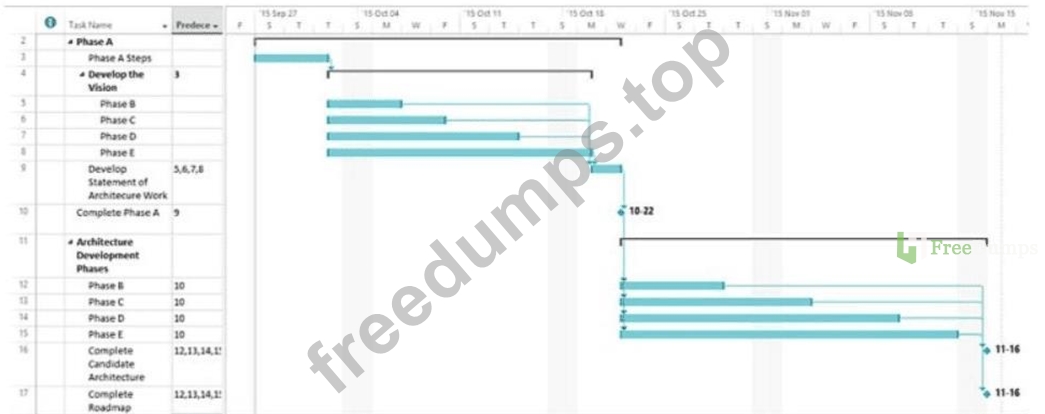
Question:
Which concept for Enterprise Architecture Practitioners does it illustrate?
- A. ADM phases must be run simultaneously until the candidate architecture is tested for acceptance.
- B. ADM phases must be run sequentially to produce a candidate architecture.
- C. Enterprise Architects must use Gantt charts to communicate the planning with stakeholders.
- D. An Enterprise Architecture must be developed in phases with fixed durations as shown.
Answer: A
Explanation:
The chart illustrates an important TOGAF concept: ADM phases can operate concurrently or iteratively rather than strictly sequentially. The diagram shows Phase A activities occurring first, after which the architecture development phases (Business, Data, Application, and Technology Architectures) overlap in time. This overlap demonstrates how architecture development work may proceed in parallel as information becomes available, allowing architects to refine and coordinate the candidate architecture more efficiently.
TOGAF explicitly supports iteration and concurrency across ADM phases. While the phases are presented in a logical order, they are not intended to be executed in a rigid step-by-step sequence in all situations. Instead, architects may work across several phases simultaneously to address dependencies, refine requirements, and accelerate the development of the candidate architecture and roadmap.
Option A best reflects this principle because it acknowledges that phases may run together as part of an iterative architecture development process until a coherent candidate architecture is produced and validated.
Option B is incorrect because TOGAF does not mandate the use of specific project management tools such as Gantt charts. Option C is incorrect because the ADM is not strictly sequential. Option D is incorrect because the duration of phases is not fixed in TOGAF.
Therefore, the chart illustrates the concept that ADM phases may be executed concurrently to develop and validate the candidate architecture.
NEW QUESTION # 49
Complete the sentence. The purpose of the Gap Analysis technique is to
- A. identify non#functional requirements for the architecture
- B. establish quality metrics for the architecture
- C. validate the architecture
- D. determine service levels for the architecture
Answer: C
Explanation:
Gap Analysis in TOGAF is a technique used to compare the baseline architecture (current state) with the target architecture (future desired state). The output is a set of gaps, representing what is missing or what must change to move from baseline to target. These gaps help validate that the target architecture is adequate:
by identifying what is not addressed, architects can ensure that all required functionality, constraints, and transformation paths are captured. In effect, Gap Analysis validates the architecture by exposing omissions, inconsistencies, or unmet requirements between what is and what should be. It is not primarily about defining service levels, non#functional requirements, or quality metrics (though it helps inform those). Rather, its main role is in validating and guiding closure of architectural gaps.
NEW QUESTION # 50
What is an objective of the ADM Preliminary Phase?
- A. To develop a vision of the business value to be delivered by the proposed enterprise architecture
- B. To select and implement tools to support the Architecture Capability
- C. To obtain approval for the Statement of Architecture Work
- D. To create the initial version of the Architecture Roadmap
Answer: B
Explanation:
The Preliminary Phase is the preparatory phase of the Architecture Development Method (ADM) cycle, which sets the context and direction for the architecture work. One of the objectives of this phase is to select and implement tools to support the Architecture Capability, which is the ability of an organization to perform enterprise architecture effectively and efficiently. Tools can include software applications, methods, techniques, standards, and frameworks that assist the architecture development and governance processes. The selection and implementation of tools should be based on the requirements and constraints of the organization, and the alignment with the Architecture Principles and the Architecture Vision3 Reference: 3: The TOGAF Standard, Version 9.2, Part II: Architecture Development Method (ADM), Chapter 6: Preliminary Phase : The TOGAF Standard, Version 9.2, Part VI: Architecture Capability Framework, Chapter 45: Establishing and Maintaining an Enterprise Architecture Capability : The TOGAF Standard, Version 9.2, Part VI: Architecture Capability Framework, Chapter 46: Tools for Architecture Development
NEW QUESTION # 51
Consider the following graphic illustrating a method supporting the TOGAF ADM.
Question:
What does the method help identify?
- A. Business Scenarios
- B. Solution Building Blocks
- C. Alternative Target Architectures
- D. Architecture Solutions
Answer: C
Explanation:
The graphic represents the Architecture Alternatives and Trade-off technique described in the TOGAF ADM guidelines. This technique evaluates different architecture options against defined criteria derived from the Architecture Vision, Architecture Principles, and Requirements. The purpose of the method is to identify and compare multiple potential architecture approaches before selecting the most appropriate one.
In practice, architects generate several candidate architectures that could meet the enterprise's needs. Each alternative is evaluated against criteria such as business value, risk, cost, compliance with principles, and alignment with requirements. Through structured comparison, stakeholders can understand the strengths and weaknesses of each alternative and select the most suitable architecture direction.
Because the evaluation process focuses on different architectural approaches for achieving the target state, the method is used to identify Alternative Target Architectures. These alternatives represent different ways the enterprise could structure its future architecture before committing to a single preferred solution.
The other options do not match the purpose of the diagram. Business Scenarios are used to understand requirements, Solution Building Blocks are implementation components, and Architecture Solutions represent final implementation outcomes rather than competing architecture options. Therefore, the method illustrated helps identify Alternative Target Architectures, making Option B the correct answer.
NEW QUESTION # 52
Which of the following does the TOGAF standard describe as a package of functionality defined to meet business needs across an organization?
- A. A deliverable
- B. A solution architecture
- C. A building block
- D. An application
Answer: C
NEW QUESTION # 53
......
It will make them scrutinize how our formats work and what we offer them, for example, the form and pattern of The Open Group OGEA-101 exam dumps, and their relevant and updated answers. It is convenient for our consumers to check The Open Group OGEA-101 Exam Questions free of charge before purchasing the The Open Group OGEA-101 practice exam.
OGEA-101 Brain Dump Free: https://www.freedumps.top/OGEA-101-real-exam.html
- OGEA-101 copyright - Key To Success [Updated-2026] ???? Search for ➽ OGEA-101 ???? and download it for free on ▷ www.practicevce.com ◁ website ????Test OGEA-101 Dumps
- Free PDF 2026 The Open Group OGEA-101: TOGAF Enterprise Architecture Part 1 Exam –Professional Free Learning Cram ???? The page for free download of ☀ OGEA-101 ️☀️ on ⇛ www.pdfvce.com ⇚ will open immediately ⤴Practice OGEA-101 Questions
- OGEA-101 Actual Dump ???? OGEA-101 Online Training ???? Practice OGEA-101 Questions ???? Search for ⏩ OGEA-101 ⏪ and download it for free on ▷ www.troytecdumps.com ◁ website ????Reliable OGEA-101 Test Testking
- Reliable OGEA-101 Test Testking ???? Test OGEA-101 Dumps ???? OGEA-101 High Passing Score ???? Easily obtain ➤ OGEA-101 ⮘ for free download through ⮆ www.pdfvce.com ⮄ ????New OGEA-101 Test Cram
- OGEA-101 Training Online ???? OGEA-101 Exam Forum ???? OGEA-101 Discount ???? Easily obtain 【 OGEA-101 】 for free download through ⇛ www.examcollectionpass.com ⇚ ????OGEA-101 Pass Guaranteed
- Pass Guaranteed The Open Group - OGEA-101 - The Best Free TOGAF Enterprise Architecture Part 1 Exam Learning Cram ???? Easily obtain free download of ⇛ OGEA-101 ⇚ by searching on ( www.pdfvce.com ) ????OGEA-101 Exam Cram
- OGEA-101 testing engine training online | OGEA-101 test dumps ???? Open ☀ www.troytecdumps.com ️☀️ enter ➽ OGEA-101 ???? and obtain a free download ????OGEA-101 Discount
- OGEA-101 Actual Dump ???? New OGEA-101 Test Cram ???? OGEA-101 Discount ???? The page for free download of [ OGEA-101 ] on ➡ www.pdfvce.com ️⬅️ will open immediately ????Practice OGEA-101 Questions
- OGEA-101 Exam Cram ☣ OGEA-101 Exam Online ???? OGEA-101 Discount ???? Search for 《 OGEA-101 》 and obtain a free download on ➥ www.prepawaypdf.com ???? ????New OGEA-101 Test Cram
- OGEA-101 Actual Dump ???? OGEA-101 Cert Guide ???? Test OGEA-101 Dumps ???? Search for ➥ OGEA-101 ???? and download exam materials for free through ✔ www.pdfvce.com ️✔️ ????Practice OGEA-101 Mock
- Pass Guaranteed The Open Group - OGEA-101 - The Best Free TOGAF Enterprise Architecture Part 1 Exam Learning Cram ???? Download ⏩ OGEA-101 ⏪ for free by simply searching on ➽ www.pdfdumps.com ???? ????OGEA-101 Online Training
- zoyaozuf633577.izrablog.com, www.stes.tyc.edu.tw, brianplhw105112.bloggosite.com, www.stes.tyc.edu.tw, arranjvvc690127.wikiconverse.com, mypresspage.com, kalexjnu431066.izrablog.com, donnakcji846886.muzwiki.com, albertzgcz349059.blogdun.com, tayawpha700718.wikiadvocate.com, Disposable vapes
BTW, DOWNLOAD part of FreeDumps OGEA-101 dumps from Cloud Storage: https://drive.google.com/open?id=1HCLuo90TtzH3NvflFialDoEqKV_D_fTr
Report this wiki page